Motivation2024 – 2026
Why metallic foams
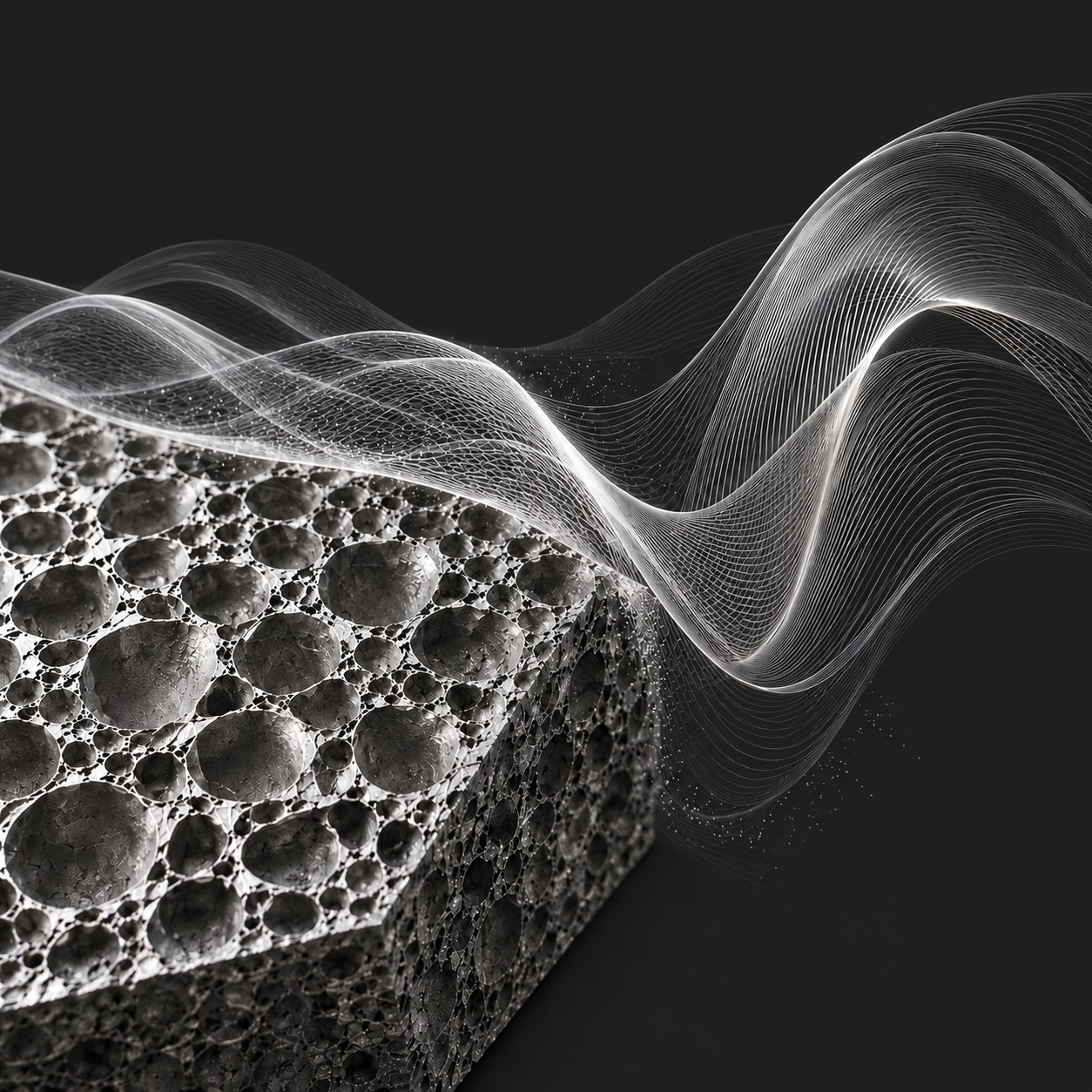
Metallic foams undergo large plastic crushing at a nearly constant plateau stress. As sacrificial claddings, they cut the peak pressure a blast delivers, stretch its duration, and absorb energy before it ever reaches the protected structure.
Eng. Struct. 2024
Modeling2024
Uniform foam efficiency
Is the damage reduction really from the foam absorbing energy, or simply from the added mass of the cladding? Comparing the bare structure, a mass-equivalent reference and the foam-clad system isolates the true contribution of energy absorption.
Eng. Struct. 2024
Modeling2024
Non-uniform foam claddings
Non-uniform aluminum foams are modeled as sacrificial layers whose density varies through the thickness. Changing that distribution changes the plateau stress, the compaction strain, how the compaction front propagates, and ultimately the structural response.
J. Build. Eng. 2024
Core method2024 – 2026
Coupled foam-structure response
Foam compaction and the protected structure's response happen together, not in sequence: the moving compaction front, the plateau stress it transmits, and the structure's own dynamic response all interact.
Eng. Struct. 2024 · J. Build. Eng. 2024
Evaluation2024 – 2026
P–I diagrams and heat maps
Pressure–impulse diagrams and heat maps evaluate foam-cladding performance across a broad blast-load spectrum, identifying where the cladding helps, where it is neutral, and where a poor foam design can lose efficiency or even worsen the response.
J. Eng. Mech. 2026 · PROTECT 2024
Design method2026
Simplified decoupled methodology
A practical analytical workflow separates foam compaction from structural response: the foam's own behavior first gives the transmitted load, then the protected structure is analyzed under that load — enabling fast design iteration without solving the fully coupled problem every time.
Int. J. Impact Eng. 2026
Evaluation2026
Energy absorption and damage mitigation
This work directly connects the share of input energy the foam absorbs with the reduction in the structure's peak displacement, tracking how the incoming energy is distributed between foam compaction, structural response, and residual kinetic and dissipation effects.
Mech. Mater. 2026
Experimental2026
UHPC beams with steel fibers
A separate experimental study, not part of the metallic-foam cladding work above: it evaluates how steel-fiber content affects the load-bearing performance, bending response and cracking behavior of ultra-high-performance concrete beams.
7th fib Congress, 2026